
Wind turbines are crucial for several reasons:
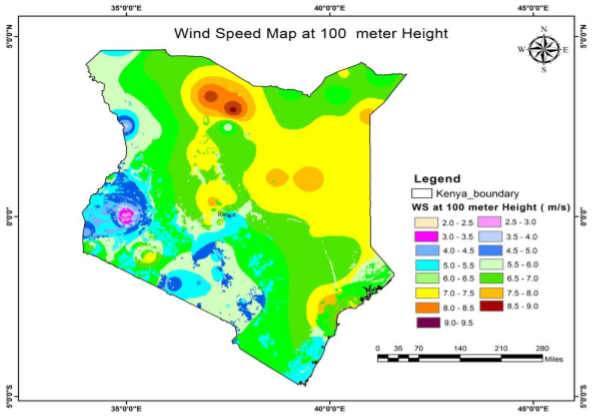
Kenya is endowed with favorable wind speeds with 73% of the country experiencing wind speeds of 6 m/s or higher at a hundred meters above ground level. Of this 28228 sq. km experiences wind speeds of between 7.5 – 8.5 m/s and 2825 sq. km experiences wind speeds of between 8.5 – 9.5 m/s.
Kenya has significant wind energy potential, particularly in regions like Marsabit and Turkana. The country’s largest wind farm, Lake Turkana Wind Power, is a key example of harnessing this potential.
How wind turbines work
Wind turbines work on a simple principle: instead of using electricity to make wind—like a fan—wind turbines use wind to make electricity. Wind turns the propeller-like blades of a turbine around a rotor, which spins a generator, which creates electricity.
Types of wind turbine
Horizontal-axis wind turbines
Horizontal-axis wind turbines (HAWTs) are the most common and efficient type of wind turbine. They typically have three blades and operate "upwind", which means that the blades face into the wind. This is because the head of the HAWT can pivot, thanks to the yaw system. (see How does a wind turbine work)
The main components (such as the generator) are located at the top of the turbine
Vertical-axis wind turbines
As the name suggests, vertical-axis wind turbines (VAWTs) have a vertical rotor shaft, and their appearance is very different from that of the more traditional HAWT.
VAWTs are omnidirectional, and so they don’t need to be adjusted in order to face the wind: this can be an asset in locations where the wind direction is very variable. They are, however, relatively rare as they are less efficient in terms of air resistance.
The turbine’s blades, shaped like airplane wings, capture wind energy
As the wind blows, it creates lift and drag forces on the blades, causing the rotor to spin
The rotor is connected to a generator, either directly or through a gearbox, which converts the mechanical energy into electricity

Importance of Wind Turbines
- Renewable Energy: They generate electricity without burning fossil fuels, reducing greenhouse gas emissions
- Cost-Effective: Wind energy is one of the most cost-effective renewable energy sources
- Job Creation: The wind industry creates numerous jobs, from manufacturing to maintenance
- Environmental Benefits: Wind turbines help reduce air pollution and water usage
- Energy Independence: They contribute to energy independence by diversifying the energy mix